
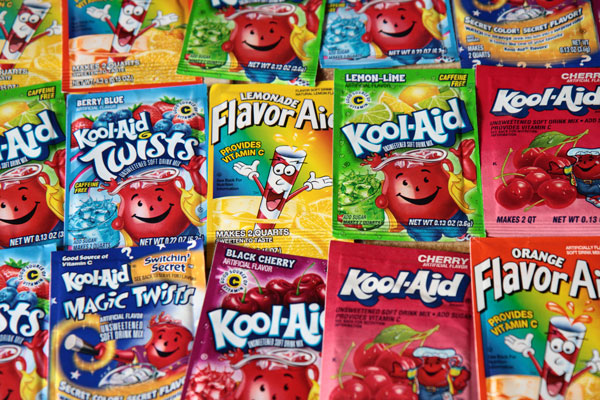
Kool Aid!
Why Kool Aid?
If you’re new to dyeing, there is no quicker, easier, safer or more reliable introduction than immersion dyeing wool with Kool Aid.
Kool Aid is technically a food stuff (although you wont catch me drinking it), so it is non-toxic and you’re totally safe to use your kitchen pans and implements. Kool Aid dyeing is an acid dyeing technique – acid reacts with protein fibres to set the dye. But, unlike other acid dyes, it already contains citric acid so it requires no additional chemicals (unless you’re dyeing stubborn fibres or plant fibres). It comes in small, manageable, measured sachets, in a rainbow of bold colours (flavours) that are washfast when set.
So why would you want to use anything else? On the downside, it would work out expensive to dye big quantities. Some of the colours are stronger than others, and there are certain shades that it’s simply impossible to create with the palette available. Some shades are also less light-fast than proper acid dyes, but don’t let that put you off!
What can be dyed?

Superwash merino 4 ply, left to right: Berry Blue & Grape; Strawberry & Orange; Strawberry, Grape & Pineapple.
You can dye any type of protein fibre based yarn using the method described below. Protein fibres include wool, alpaca, silk, cashmere – basically, animal fibres. Some fibres absorb dye more easily than others, superwash merino is ideal – the superwash treatment helps the yarn suck-up dye, giving vibrant colours, while silk and cashmere require more treatment in order to get the dye to set.
You don’t have to use yarn – top (roving), felt and finished items can also be dyed. If using fleece of handspun yarn, make sure it’s been properly cleaned and all the oil removed.
Cellulose (plant) fibres such as cotton, linen, bamboo and tencel cannot be dyed using this technique. There are ways to dye cellulose fibres with Kool Aid but they are not described here.
If you’re dyeing yarn made from a blend of animal and plant fibres, the dye will take to the animal fibre content only, so overall the colours will be paler.
Equipment & supplies
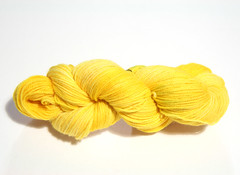
Superwash merino 4 ply dyed with Pina Pineapple
What you need
- Undyed protien-based yarn (wool, silk, alpaca etc.). If you’re new to this, use superwash wool – it absorbs colour more easily and there is no danger of accidentally felting it.
- Kool Aid (see table below for quantities)
- A stainless steel pan, large enough for your yarn
- A plastic or metal stirring implement
- Rubber gloves
Optional extras
- White vinegar (50 ml per 100 g yarn) or citric acid (10 g per 100 g yarn) to aid dye fixing on stubborn fibres only (silk, cashmere, alpaca etc.)
- Salt (25 g per 100 g yarn) to slow dye absorption, giving an even colour
I have found citric acid slightly more reliable than white vinegar, but vinegar is much easier to get hold of.
Kool Aid strength chart
| Strawberry / cherry | Orange | Pineapple | Lemon Lime | Berry Blue | Grape | |
|---|---|---|---|---|---|---|
| Colour | scarlet red | orange | golden yellow | green | turquoise blue | dark purple |
| sachets / 100 g | 3 | 4 | 4 | 6 | 4 | 4 |
Method
Soaking
- Soak the yarnin enough warm water to cover with a drop of washing up liquid for at least 30 minutes.
- If using citric acid, dissolve it in a small amount of boiling water, then mix with enough warm water to cover the yarn. Wear gloves when handling citric acid if you have sensitive skin – it is not harmful but may cause irritation.
- If using white vinegar, simply mix it with the water.
Soaking helps the yarn absorb dye quickly and evenly. The washing-up liquid aids wetting by breaking the surface tension.
- Once soaked, remove moisture by gently squeezing. Do not wring as this may damage fibres.
Making single coloured skeins
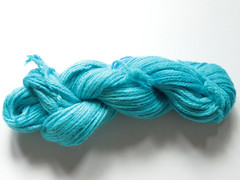
Merino aran dyed with Berry Blue
- Add to a pan, enough warm water to cover your yarn – the actual amount is not important. If you’re using salt, add it now and mix until dissolved
- Add the Kool Aid and mix well. The colour of the dye bath will be very close to the final colour of the yarn so you can make changes at this point by adding more packets, for example if you want your green to be bluer.
- Add the yarn to the dyebath and push it under, making sure it’s fully submerged.
- Turn on the heat, bring to the boil.
- Simmer for 30 minutes. By this time all the dye should have absorbed and the water will be clear (or milky with certain shades).
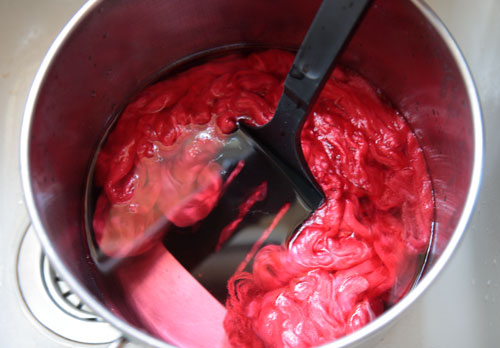
The liquid turns clear when all the dye has been absorbed
Making multi-coloured skeins

Kool Aid rainbow: 1 x Pineapple, 1 x Strawberry, 1 x Berry Blue, 1 x Grape
- Place the yarn in a large, flat saucepan (a sauté pan is ideal), and add enough warm water to cover.
- Empty different colours of Kool Aid into different areas on the pan and very gently agitate each area using a chopstick until the powder dissolves.
- Turn on the heat, gently bring to the boil.
- Simmer gently for 30 minutes, do not allow to boil vigorously while the water contains colour.
Rinsing
- Leaving the yarn in the dyebath, allow it to cool until it is handleable for superwash, or room temperature for everything else.
- Rinse using water of the same temperature as the dye bath, taking care to only agitate the yarn while submerged, until the water runs clear. Do not be alarmed if takes several rinses, especially with red colours.
- Gently squeeze the water out of the yarn. Remove excess by rolling it in a towel or using a washing machine delicate spin cycle. Hang to dry.
- Admire your work!
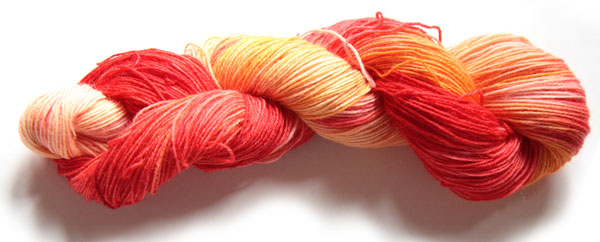
superwash BFL sock dyed with 1 x Pineapple, 1 x Orange, 2 x Strawberry, using multi-coloured method
Links & UK Stockists

Keep samples with dye recipes for future reference
- Kool Aid World – a vast range of flavours, and do a good value 27 pack set for £16
- DT Crafts – dyers favourite Kool Aid shades (with colour charts) for 45p per sachet, plus other dyeing supplies like citric acid
- What a Kool Way to Dye – Ravelry group dedicated to dyeing with Kool Aid and food colouring
- Texere – good value undyed yarns
- Self-striping yarn with Kool Aid by Eunny Jeng
- Kool Aid dyeing on Knitty
- Kool Aid colour chart
- Kool Aid colour chart showing mixed colours and stronger concentrations


Thank you for this blog; I’m wanting to start dyeing and I appreciate the easy to follow directions and all the good info!
This is a fantastic tutorial, really useful. Thank you so much for writing it up! (& for being so thorough) – I’m sure I’ll come back to it often, brilliant! Can’t wait to get stuck in now, didn’t realise it was quite straight forward…
Love your Berry Blue and Grape!
Ditto Giselle’s comment – v useful, thank you!
thank u for the idea
FANTASTIC instructions, thank you so much for posting!
Thank you as i was given a few packs and didnt want to use them for drinks im going to try and dye a woolen shawl
Thank you for a simple instruction! :)
I just got the most horrible shade of, “Tea Rose,” ever. I mean it looks like the color of my eldest son’s skin. It’s great on his bod, adorable and Hispanic, but on me? Not so much. Especially since I got it to make a pretty pink stole out of. So, now do I not only have to dye it, I have to over-dye it. I would send it back, but being 100% honest, I never and I mean NEVER return anything. I intend to and intentions are great, but this is a gift for my Stepmother, who has my coloring. Again, pretty color, not on us.
So, after searching all over the internet, and looking at all the tutorials I could find, in two days, I proclaim this one, THE BEST! It’s clear, and makes the whole thing seem so doable, that next time I’m going to get yarn that is for dying and do it from that color.
I swore I would never be a dyer. NEVER. However, if this comes out, I may eat my words. Thank you.
Hi Nancy,
I’m glad you found it useful! Let us know how you get on :)
Suzie
Hi, this might be a silly question but here goes.. The yarn comes on a spool right? So when you take it off the spool to dye it do you wrap it round something or what? Does it need to be in a big loop? I can’t wait to get started, hope that makes sense. K.
Hi Karen,
Undyed yarn often comes as a ‘skein’, which is basically a big loop as you say! If your yarn is in a ball or on a spool, you can skein it by wrapping around your elbow and between your finger and thumb. You can also use a little gadget called a Niddy Noddy for this. It’s important to tie the skein (loosely) in a couple of places, otherwise you’ll end up with a big tangle in the dye bath!
I hope that helps!
Suzie
Great tutorial! Advice needed though:
How well in your experience does this dyeing process hold? I’m about to dye some merino fabric to line the inside of a pair of gloves. And I know that merino holds dye really well, but I’m worried over time and with heat and moisture from warm palms that the dye may come off and my brother will be left with purple hands :P Is it all about the vinegar?
I’m going to do my best to heat set it a few times, but any other ideas or advice on how to to make dyes really hold and not come off later on?
Hi Kayo,
I knitted socks from my KoolAid dyed yarn and I can happily say that I never got purple feet! The colour is not as intense as when I first made them but they are 4 years old! If you follow the method in the tutorial, the only chance of colour bleeding is on first wash if you’ve made it very saturated with colour. If you’re at all concerned, machine-wash the yarn on a wool-safe setting after you’ve dyed it.
Suzie
i have a wool poncho which i really like, the only problem it is red. would i be able to dye it using this method? i think i would wear it more if it was a dark colour
Hi Diane,
Yes, if your poncho is 100% wool it should work! For a whole garment you would need a lot of KoolAid and a very large pan. To make a red colour a darker red or brown, you’d need to dye it in a bath of greenish-blue dye, counter-intuitive as that may seem. You might also be able to achieve a purple-ish shade with professional acid dye pigment in a violet shade but not with the colours available with KoolAid.
Good luck with it! Let us know how you get on.
I’ve been wanting to get a rug that is no longer in stock. I’ve found a black and white rug as a substitute and wondered if I could dye it. Since the rug already has “FAMILY” printed on it in black, do you think it’s still possible to dye the white area with your Kook-Aid technique?
See here for reference: http://www.trendir.com/interiors/interior-decorating-with-rugs-by-novogratz-the-family-rug.html
Thanks,
natalie
How – does the colour wash out afterwords? Have you tested it?
Hi Chrisi – no the colour doesn’t wash out, it is colour fast just like normal synthetic dye. I still have my KoolAid dyed socks, they’ve faded a little with many washes but the colour does not run.
I dye all my wool that I spin in koolaid and it works great. Not so much will llama wool. Have you tried to dye just llama wool? It doesn’t seem to hold the color as well.
Hi Connie,
I have not tried llama wool but all fibres are different. With stubborn fibres you might need to add extra citric acid to the mix. 10g citric per 100g fibre should be enough. Let us know how you get on!
Suzie
Hello hello!
I never dye anything in my life and for some odd reason I thought about it at work! So, off i go to get some kool aid packages. I use Peruvian Highland wool in a pastel blue , not the whole ball, just a little bit to tested it out. It turn out amazing! I didn’t put citric or anything in it though. I shouldn’t have use bits of yarn to tie the hank together because there was spots where the dye didn’t get absorbed. Lesson learn!
Nice tutorial suzie!
Hi Miki, I’m glad it turned out well!
There are a couple of things that would solve the problems you had with undyed spots. If you add salt to dye bath it will slow down the absorption and make the dye absorb more evenly. I think about 50g per 100g of yarn is recommended, which sounds like a lot! The other thing to do is tie your skeins loosely. I normally use yarn, but sewing thread might work better. Good luck!
Can I dye a shawl that I’ve already knitted up? I ordered the wool online and didn’t love the color once I got it in the mail, but proceeded anyway. It’s a KnitPicks Palette fingering 100% wool in a color called Clematis Heather – a red violet with flecks of golden yellow, but all muted together. To me, it’s almost a non-color from a distance – if there’s any such thing.
Thanks in advance for your reply.
Yep! As long as you have a pan big enough there is no reason why you can’t dye a finished garment. If you want to achieve an even colour I recommend using salt to slow the absorption of the dye.
Hi, I am thinking of giving yarn dyeing a go and thought it would be easiest to try with kool aid. I was wondering, if I wanted to use 2 colours, would I use the full amount for each colour which is in your chart. For example 4 of berry blue and 4 of grape or does it get halved when using more than one colour? Thanks
Hi Charlotte,
As a rule of thumb you would halve the quantities if mixing colours, but some are stronger than others and it all depends how saturated you want the final shade to be. It’s really a matter of trial and error. Do let us know how you get on though!
Suzie
Just read your tutorial to refresh my memory, since it’s been a few years since I dyed yarn with Kool Aid, and found your directions spot on. However, for those who’re not sure about the whole dying with a soft drink mix thing, let me assure them that it does work well, and doesn’t “bleed” – if your child has ever spilled Kool Aid on him/herself, you know that it does stain — forever! Some of the colors mentioned have been discontinued – Booberry is one that I love, and can’t find. It gives a lovely shade of aqua, and I’m searching for a comparable color, so have bought a couple to test. If your new dyers aren’t sure, wind a few yards/inches, and mix up a tiny bit of dye just to see the result. I’m thinking about 1 tsp. or even less, to a half cup water should give a pretty good indication of your final color. Thanks again!
I just used a full pack of grape koolaid and about half a tsp of blue food coloring to 3 50g skeins of a dingy gray vintage alpaca blend called alpasilk by Phildar. I was going for a tydye like effect so no salt. The yarn was a blend of silk mohair alpaca. I put the koolaid on one side and the blue on the other leaving the middle plain so that the colors would bleed or blend into the middle leaving light bluish patches. I also did not soak my yarn first. I started with super hot water from my sink and immersed and allowed to simmer. I used the same bath for each batch adding the same amount of dye each time. It was gorgeous!
Amazing post, thank you so much ! I am dyeing for the first time ever. I appreciate the instructions ! :-)